Skip to content

VirtuallyThatGuy

Anything VMware , PowerCLI, PowerShell, Automation and some Windows

Menu
  • Home
  • PowerCLI
  • VMware
  • Automation
  • Windows
  • About
Menu

How To Increase VMware Datastore Using Powershell or Powercli – VirtuallyThatGuy

Posted on February 29, 2020December 19, 2025 by VirtuallyThatGuy

This is a quick blog post on how to increase VMFS datastore size using powercli. I recently installed workstation on my desktop to run nested vSAN for testing. I found out that using the native UI took a while so took the challenge to use cli instead.
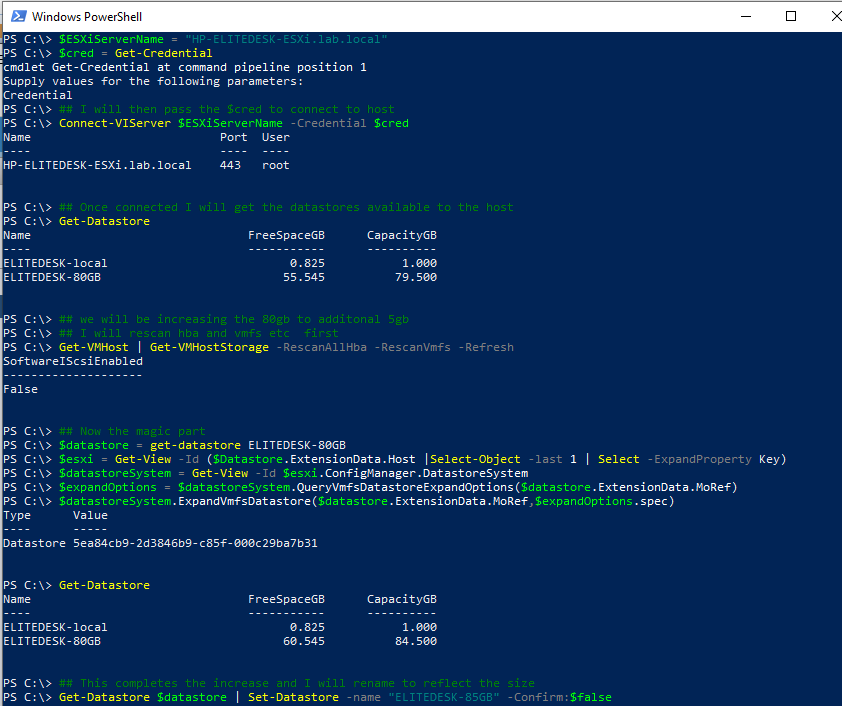
Script used below:

$ESXiServerName = "HP-ELITEDESK-ESXi.lab.local"                                                                 
$cred = Get-Credential

## I will then pass the $cred to connect to host                                                                
Connect-VIServer $ESXiServerName -Credential $cred

## Once connected I will get the datastores available to the host                                               
Get-Datastore

## we will be increasing the 80gb to additonal 5gb                                                              
## I will rescan hba and vmfs etc  first                                                                        
Get-VMHost | Get-VMHostStorage -RescanAllHba -RescanVmfs -Refresh

## Now the magic part                                                                                           
$datastore = get-datastore ELITEDESK-80GB                                                                       
$esxi = Get-View -Id ($Datastore.ExtensionData.Host |Select-Object -last 1 | Select -ExpandProperty Key)        
$datastoreSystem = Get-View -Id $esxi.ConfigManager.DatastoreSystem                                            
$expandOptions = $datastoreSystem.QueryVmfsDatastoreExpandOptions($datastore.ExtensionData.MoRef)              
$datastoreSystem.ExpandVmfsDatastore($datastore.ExtensionData.MoRef,$expandOptions.spec)

## This completes the increase and I will rename to reflect the size                                           

Get-Datastore -Name $datastore | Set-Datastore -name "ELITEDESK-85GB" -Confirm:$false

2 thoughts on “How To Increase VMware Datastore Using Powershell or Powercli – VirtuallyThatGuy”

  1. Corey says:
    July 8, 2020 at 3:40 am

    updated version for you select the datastore

    $ESXiServerName = “HP-ELITEDESK-ESXi.lab.local”
    $cred = Get-Credential

    ## I will then pass the $cred to connect to host
    Connect-VIServer $ESXiServerName -Credential $cred

    ## Once connected I will get the datastores available to the host
    Get-Datastore

    $selecteddatastore = Get-Datastore | Out-GridView -Title ‘Choose one or more datastore’ -PassThru

    ## we will be increasing the 80gb to additonal 5gb
    ## I will rescan hba and vmfs etc first
    Get-VMHost | Get-VMHostStorage -RescanAllHba -RescanVmfs -Refresh

    foreach($datastore1 in $selecteddatastore) {
    ## Now the magic part
    $datastore = get-datastore $datastore1.Name
    $esxi = Get-View -Id ($Datastore.ExtensionData.Host |Select-Object -last 1 | Select -ExpandProperty Key)
    $datastoreSystem = Get-View -Id $esxi.ConfigManager.DatastoreSystem
    $expandOptions = $datastoreSystem.QueryVmfsDatastoreExpandOptions($datastore.ExtensionData.MoRef)
    $datastoreSystem.ExpandVmfsDatastore($datastore.ExtensionData.MoRef,$expandOptions.spec)

    ## This completes the increase and I will rename to reflect the size

    Get-Datastore -Name $datastore | Set-Datastore -name $datastore1.Name -Confirm:$false

    }

    Reply
    1. VirtuallyThatGuy says:
      August 7, 2020 at 10:00 am

      thanks buddy for contributing to the community

      Reply

Leave a Reply Cancel reply

Your email address will not be published. Required fields are marked *

Recent Posts

  • vROps: Management Pack Troubleshooting
  • Windows AD {Active Directory} (PowerShell) samples
  • Migrate VMs Between vCentres Using Powershell or PowerCLI
  • Set VM Tools to Update Automatically on VM Reboot using powershell
  • Windows Administrator Must Have Powershell Commands

Recent Comments

  • JB on Script: How to get VM with Tag Assignment and export results to csv using PowerCLI or Powershell
  • DL on How to change VCSA root password and bypass BAD PASSWORD: it is based on a dictionary word for vCenter VCSA root account warning
  • 360coolp on How to change VCSA root password and bypass BAD PASSWORD: it is based on a dictionary word for vCenter VCSA root account warning
  • Yogesh on ESXi 8.x, 7.x, 6.x Service sfcbd-watchdog Not Running / Fails to Start – VirtuallyThatGuy
  • VirtuallyThatGuy on ESXi 8.x, 7.x, 6.x Service sfcbd-watchdog Not Running / Fails to Start – VirtuallyThatGuy

Archives

  • March 2023
  • February 2023
  • January 2023
  • December 2022
  • November 2022
  • October 2022
  • September 2022
  • August 2022
  • July 2022
  • June 2022
  • May 2022
  • April 2022
  • March 2022
  • February 2022
  • January 2022
  • December 2021
  • November 2021
  • October 2021
  • September 2021
  • August 2021
  • July 2021
  • June 2021
  • May 2021
  • April 2021
  • March 2021
  • February 2021
  • January 2021
  • December 2020
  • November 2020
  • October 2020
  • September 2020
  • May 2020
  • April 2020
  • March 2020
  • February 2020
  • January 2020
  • December 2019
  • November 2019
  • October 2019
  • September 2019
  • August 2019
  • July 2019
  • May 2019
  • April 2019
  • March 2019
  • February 2019
  • January 2019
  • December 2018
  • November 2018
  • October 2018
  • July 2018
  • June 2018
  • May 2018
  • April 2018
  • March 2018
  • February 2018
  • January 2018
  • December 2017

Categories

  • Automation
  • PowerCLI
  • VMware
  • Windows
© 2026 VirtuallyThatGuy | Powered by Superbs Personal Blog theme